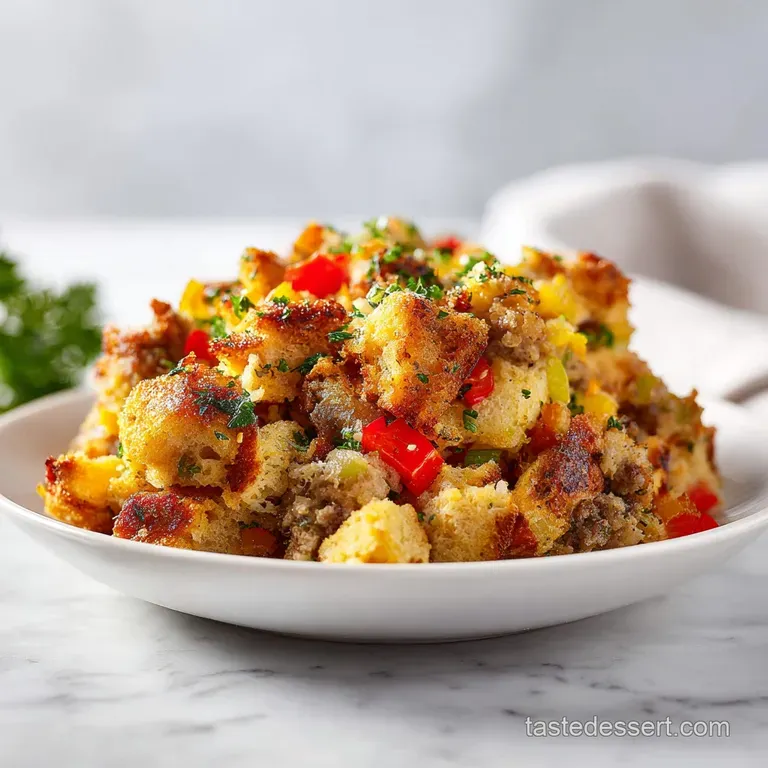
Easy Stuffing Recipe: Buttery Herb Crumb

- Time: Active 20 minutes, Passive 45 minutes, Total 1 hour 5 minutes
- Flavor/Texture Hook: Buttery, herb forward crumb with crispy golden edges
- Perfect for: Holiday gatherings, Sunday roasts, or beginner cooks needing a fail proof side
- Mastering This Easy Stuffing Recipe
- Essential Science of the Soak
- Important Success Benchmarks to Track
- Building Layers of Savory Flavor
- Essential Tools for Golden Results
- Steps for a Perfect Bread Bake
- Rescuing Texture and Balancing Salt
- Creative Twists for Every Table
- Holiday Myths and Common Misconceptions
- Smart Storage and Fresh Reheating
- Pairing Your Dish With Everything
- Recipe FAQs
- 📝 Recipe Card
Mastering This Easy Stuffing Recipe
Think about the first time you stood in a kitchen during the holidays. For me, it was the sound of a full cup of butter hitting a warm pan, that sudden hiss and sizzle as the moisture evaporated and the fat began to foam.
Then came the onions and celery, hitting the heat and releasing that specific, sweet aroma that somehow signals "home" more than any other smell. It's a sensory trigger that still makes me lean over the stove and close my eyes every single time.
But let's be real, we've all had that one year where the stuffing was... well, a bit of a disaster. I once tried to rush the process by using fresh, soft sandwich bread straight from the bag. I ended up with a mushy, soggy bread pudding that looked nothing like the beautiful, structured dish I'd imagined.
It was a lesson learned the hard way: great stuffing isn't just about the ingredients, it's about the transformation of textures. We aren't just mixing things together, we're building a foundation that can hold moisture without losing its soul.
This easy stuffing recipe is the result of those messy experiments. We're going to take a pound of simple bread and turn it into something delightful using techniques that focus on flavor layers. You'll get the crunch you want on the top and that soft, herb soaked middle that everyone fights over.
Whether you're a seasoned pro or this is your first time hosting, I'm here to walk you through the tiny tricks that make a huge difference. Let's get the oven preheated and start dicing.
Essential Science of the Soak
The secret to a successful bake lies in how we manage the hydration of the bread. If we just poured broth over fresh bread, the starch molecules would immediately collapse. By using dried or toasted cubes, we create a rigid structure.
When the liquid hits those cubes, the Starch Gelatinization process begins, allowing the bread to swell and soften without turning into a paste. The eggs then act as a Protein Binder, coagulating as the temperature rises to 160°F (71°C), which ensures your scoop holds its shape on the plate.
Aromatic Infusion: Sautéing your yellow onion and celery in a full cup of butter isn't just about softening them. It releases fat soluble flavor compounds from the sage and thyme, which then coat every single bread cube.
| Method | Time | Texture | Best For |
|---|---|---|---|
| Oven Bake | 45 minutes | Crispy top, moist middle | Standard holiday dinners |
| Stovetop | 25 minutes | Uniformly soft and fluffy | Quick weeknight side dishes |
| Slow Cooker | 4 hours | Dense and very moist | Saving precious oven space |
While the oven is the gold standard for that golden brown crust, sometimes your kitchen logistics demand a different path. If you find yourself out of oven real estate, the stovetop method works, but you'll miss out on that specific "shatter" of the top layer.
For this recipe, we're focusing on the oven because the contrast between the velvety interior and the crispy edges is what makes it truly special.
Important Success Benchmarks to Track
To ensure you're on the right track, keep an eye on these three precision checkpoints. First, your onions and celery should sizzle gently in the butter for 8 to 10 minutes until they're translucent and tender, but not browned.
Second, when you mix the broth and eggs, the liquid should look like a thin, pale gold custard. Finally, your oven should be set to 180°C (350°F). If it’s too hot, the top will burn before the middle sets, and if it's too cool, the bread will just sit and get soggy.
We are aiming for a specific weight and volume ratio. One pound of bread cubes is exactly enough to soak up the 3 cups of chicken broth without leaving a pool of liquid at the bottom of the bowl.
If you see liquid sitting in the bottom after mixing, give it another 5 minutes to soak before putting it in the pan. This patience ensures that every bite is equally seasoned and hydrated.
Building Layers of Savory Flavor
The alchemy of this dish starts with choosing the right bread. While a standard white loaf works, using a rich brioche adds a buttery depth that is simply transforming. The bread needs to be dry enough to "clink" when you toss it in a bowl. If it’s soft, the texture will be ruined.
| Component | Science Role | Pro Secret |
|---|---|---|
| Bread Cubes | Structural Foundation | Toast at 300°F (150°C) for 15 minutes if not stale |
| Unsalted Butter | Flavor Carrier | Use high-quality butter for a richer mouthfeel |
| Chicken Broth | Hydration & Umami | Use low sodium to control the final saltiness |
| Large Eggs | Texture Stabilizer | Whisk into cooled broth to avoid scrambling |
For your aromatics, we're using 2 cups of yellow onion and 1.5 cups of celery. Don't throw away the leafy tops of the celery! They have an intense, herbal flavor that mimics parsley and adds a beautiful green fleck to the final dish. This recipe also leans heavily on fresh sage and thyme.
If you've only ever used the dried stuff in the little tins, using fresh leaves will be a total revelation for your taste buds.
Ingredients List & Substitutes:
- 1 lb white bread or brioche: The backbone of the dish. Why this? Brioche adds a rich, slightly sweet fat content.
- Substitute: Sourdough bread for a tangy, firmer texture.
- 1 cup unsalted butter: Provides the velvety mouthfeel. Why this? Allows you to control the salt levels manually.
- Substitute: Vegan butter or high-quality olive oil.
- 2 cups yellow onion: Adds sweetness and base flavor. Why this? Yellow onions have the best sugar to sulfur balance.
- Substitute: Leeks or shallots for a milder, more delicate taste.
- 1.5 cups celery: Provides essential crunch and "holiday" aroma.
- Substitute: Fennel bulb for a slight aniseed undertone.
- 4 cloves garlic: For a punch of savory depth.
- Substitute: 1 teaspoon garlic powder if fresh isn't available.
- 3 cups low sodium chicken broth: The primary hydrating element.
- Substitute: Vegetable broth for a vegetarian friendly version.
- 2 large eggs: The glue that holds the structure together.
- Substitute: 1/2 cup extra broth (will result in a looser texture).
- Fresh Herbs (Parsley, Sage, Thyme): The aromatic soul of the recipe.
- Substitute: Dried herbs (use 1/3 of the fresh amount).
Similar to how you'd balance the moisture in a Chicken and Dumplings recipe, the ratio of liquid to starch here is everything. Too much and it's a sponge, too little and it's a crouton.
Essential Tools for Golden Results
You don't need a professional kitchen, but a few specific tools will make this easy stuffing recipe much smoother. A large, heavy bottomed skillet or Dutch oven (like a Le Creuset) is perfect for sautéing the vegetables because it distributes heat evenly, preventing the butter from scorching.
You'll also need a massive mixing bowl bigger than you think. You need space to toss the bread cubes with the butter and broth without crushing them into dust.
For the bake, a 9x13 inch ceramic or glass baking dish is the standard. If you use a metal pan, keep an eye on the bottom as it may brown faster. I also recommend a good kitchen scale to weigh your bread.
"One pound" can look very different depending on the density of the loaf, and precision here prevents a dry finished product. Finally,, a silicone spatula is my best friend for folding the ingredients together gently.
Steps for a Perfect Bread Bake
- Prep the bread. Cut your 1 lb of bread into 1 inch cubes. If they aren't already bone dry, spread them on a baking sheet and toast at 150°C (300°F) for 15 minutes until they feel like croutons.
- Sauté aromatics. Melt 1 cup of unsalted butter in a large skillet over medium heat. Add 2 cups diced onion and 1.5 cups sliced celery. Note: This stage builds the flavor base.
- Softening. Cook for 8-10 minutes, stirring occasionally, until the onions are translucent and the celery is tender.
- Add garlic and herbs. Stir in 4 cloves of minced garlic, 1 tbsp minced sage, and 1 tbsp thyme. Cook for 1 minute until the air smells intensely fragrant.
- Cool the mixture. Remove the skillet from the heat and let it cool for 5 minutes. This prevents the eggs from cooking instantly when they meet the fat.
- Whisk the liquids. In a separate bowl, whisk 3 cups chicken broth with 2 large eggs, 1 tsp salt, 1 tsp pepper, and 0.25 cup parsley.
- Combine. Place bread cubes in a large bowl. Pour the butter and vegetable mixture over them, then add the broth mixture. Note: Use a folding motion to keep the cubes intact.
- Hydrate. Let the mixture sit for 5 minutes until the bread has absorbed most of the liquid.
- Bake part one. Transfer to a greased 9x13 dish. Cover with foil and bake at 180°C (350°F) for 25 minutes. This steams the center to a velvety soft texture.
- Bake part two. Remove the foil and bake for another 20 minutes until the top is golden brown and the edges are crackling.
Chef's Tip: If you're using a very dense bread like sourdough, you might need an extra 1/4 cup of broth. Give the cubes a squeeze; they should feel like a damp sponge, not a dripping one.
Rescuing Texture and Balancing Salt
Even with a simple recipe, things can go sideways. The most common issue is the "soggy bottom," usually caused by adding too much liquid or not toasting the bread enough. If this happens, don't panic. You can often save it by extending the "uncovered" baking time.
On the flip side, if the stuffing looks like a tray of dry crackers, a quick drizzle of warm broth can work wonders.
Dry or Sandy Mouthfeel
This usually happens if the bread cubes were too large or if the egg to broth ratio was slightly off, causing the bread to stay hard in the center. The fix is simple: drizzle about 1/4 cup of warm chicken broth over the dry areas and cover it back up with foil for 10 minutes.
The Soggy Bottom Syndrome
If your stuffing is swimming in liquid, the bread was likely too fresh and couldn't hold its structure. The best way to fix this is to spread the stuffing out into a larger pan to increase the surface area and bake it uncovered at a slightly higher temperature for 10 minutes.
| Problem | Root Cause | Solution |
|---|---|---|
| Too Salty | High sodium broth used | Add more toasted bread or a squeeze of lemon juice |
| Bland Flavor | Under seasoned vegetables | Fold in more fresh parsley and a pinch of salt before the final bake |
| Greasy Texture | Butter didn't emulsify | Stir the mixture more thoroughly before baking to distribute fat |
Common Mistakes Checklist:
- ✓ Never use fresh bread; always dry it out in the oven or leave it on the counter for 24 hours.
- ✓ Don't skip the eggs; they provide the necessary structure and "custardy" interior.
- ✓ Avoid over mixing; you want distinct bread cubes, not a mashed potato consistency.
- ✓ Ensure the broth is cooled slightly before adding eggs to prevent unappetizing "scrambled egg" bits.
- ✓ Preheat your oven fully; putting the dish into a cold oven leads to uneven hydration.
Creative Twists for Every Table
While the base recipe is a classic for a reason, it's incredibly easy to adapt. If you're a fan of the Thanksgiving Stuffing recipe that uses sourdough, you can swap the bread 1:1 here. For those who love a bit of sweet and savory contrast, adding 1/2 cup of dried cranberries or a diced Granny Smith apple during the sauté stage works beautifully.
Easy Stuffing Recipe with Sausage
Brown 1 lb of Italian sausage or breakfast sausage in the skillet before adding the butter and vegetables. The rendered pork fat adds an incredible layer of umami. Just be sure to drain the excess grease if it seems like too much, or your stuffing might end up heavy.
Easy Vegetarian Stuffing Recipe
Simply swap the chicken broth for a high-quality vegetable stock. To make up for the loss of meat based umami, I like to add 1 cup of chopped sautéed mushrooms or a tablespoon of soy sauce to the broth mixture.
| Servings | Bread Amount | Broth Amount | Pan Size |
|---|---|---|---|
| 5 People | 0.5 lb | 1.5 cups | 8x8 inch square |
| 10 People | 1 lb | 3 cups | 9x13 inch rectangle |
| 20 People | 2 lb | 6 cups | Two 9x13 inch pans |
When scaling up, remember that cooking times may increase by 10 to 15 minutes because the thermal mass of the larger batch takes longer to heat through. If you are making a massive batch for a party, work in two separate pans rather than one giant deep dish to ensure the middle cooks properly.
Holiday Myths and Common Misconceptions
One of the biggest myths is that stuffing must be cooked inside the bird to be authentic. In reality, cooking stuffing inside a turkey often leads to either overcooked meat or undercooked (and potentially unsafe) stuffing.
Baking it in a separate dish, technically making it a "dressing," gives you much more control over the texture and allows for those crispy top edges that everyone loves.
Another misconception is that stale bread is the same as toasted bread. Stale bread has simply undergone starch retrogradation, where the moisture migrates from the starch to the crust. Toasted bread has actually had the moisture removed.
For the best "easy stuffing recipe", I always recommend toasting your cubes in a low oven; it creates a much more reliable "crunch" than just letting a loaf sit out on the counter.
Smart Storage and Fresh Reheating
You can easily make this dish ahead of time. Prepare the entire recipe up until the point of baking, then cover the dish tightly with plastic wrap and store it in the fridge for up to 24 hours. When you're ready to eat, just pop it in the oven.
You may need to add an extra 5 to 10 minutes to the covered bake time since the dish is starting out cold.
- Storage: Keep leftovers in an airtight container in the fridge for up to 4 days.
- Freezing: Stuffing freezes surprisingly well! Wrap tightly in foil and plastic wrap; it will stay fresh for up to 3 months. Thaw in the fridge overnight before reheating.
- Zero Waste: If you have leftover bread heels or scraps, don't toss them! Toss them in a food processor to make homemade breadcrumbs. You can also use leftover stuffing as a base for "stuffing waffles" the next morning just press it into a hot waffle iron until crispy!
Pairing Your Dish With Everything
This stuffing is a team player. While it’s the natural partner for a roast turkey or chicken, it also holds its own next to a glazed ham or even a thick cut pork chop. Because it's so herb forward, it pairs beautifully with acidic sides like cranberry sauce or a bright, vinegary kale salad to cut through the richness of the butter.
Trust me, once you master the balance of the broth soak and the two stage bake, you'll never go back to the boxed stuff. There is something so satisfying about pulling a tray of golden, fragrant bread out of the oven and knowing you built those layers of flavor yourself.
It’s comforting, it’s nostalgic, and honestly, it’s usually the first thing to disappear from the table. Happy cooking!

Recipe FAQs
What is the secret to good stuffing?
Toasting the bread until it resembles croutons. Stale or toasted bread absorbs the liquid evenly without collapsing into mush, which is crucial for that perfect contrast between the soft middle and crispy top.
What does adding an egg to stuffing do?
Yes, eggs act as a primary binder. They coagulate during baking, holding the stuffing's structure together so it scoops out cleanly instead of crumbling apart on the plate.
How to make simple stuffing for chicken?
Sauté aromatics in butter until translucent, then fold into dried bread cubes. Whisk broth and eggs together, gently mix into the bread, and bake separately in a greased dish for the best texture control.
Is it true that you must cook stuffing inside the turkey for it to be authentic?
No, this is a common misconception. Cooking stuffing separately (as a dressing) allows you to control the hydration, guaranteeing a safer internal temperature and a superior crispy crust.
What ingredients are standard in a homemade easy stuffing recipe?
Dried bread cubes, sautéed onion and celery, butter, chicken broth, eggs, and fresh herbs like sage and thyme. These form the core flavor and texture profile for a successful bake.
How do I ensure my stuffing isn't too salty?
Use low-sodium broth and taste the vegetables before adding the liquid. Since sausage and store-bought broth are often high in salt, using low-sodium broth gives you granular control over the seasoning.
What is the best way to reheat leftover stuffing for a perfect texture?
Reheat covered with foil initially, then uncover for the final 10 minutes. Covering traps steam to reintroduce moisture, while uncovering crisps the surface again, much like the initial bake. If you enjoyed controlling the moisture absorption here, the same heat distribution principles apply when reheating dishes like our Honey Butter Recipe.
Easy Stuffing Recipe Buttery Herb

Ingredients:
Instructions:
Nutrition Facts:
| Calories | 319 calories |
|---|---|
| Protein | 6g |
| Fat | 21g |
| Carbs | 26g |
| Fiber | 2g |
| Sugar | 4g |
| Sodium | 451mg |
