The Summer Garden Blackberry Lemon Swiss Roll
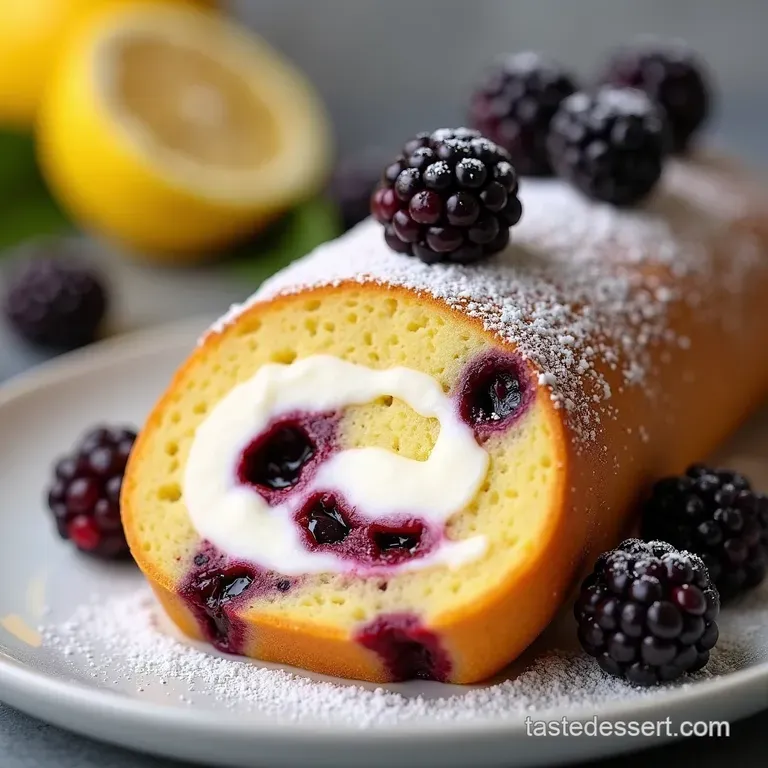
- Unveiling the 'Summer Garden' Blackberry Lemon Swiss Roll Masterpiece
- Why This Blackberry Lemon Cake Roll Triumphs Over the Ordinary
- The Essential Pantry List for a Flawless Sponge
- Curating the Components: Blackberry Swirl & Lemon Cream
- Baking the Tender Sponge: Gentle Mixing for Maximum Airiness
- Assembling the Blackberry Lemon Cake Roll: Precision in Every Layer
- Mastering Storage and Serving Suggestions for Your Creation
- Pro Tips for Troubleshooting Your Rolled Sponge Cake
- Recipe FAQs
- 📝 Recipe Card
Unveiling the 'Summer Garden' Blackberry Lemon Swiss Roll Masterpiece
Transport yourself to a sun-drenched English garden with this elegant Blackberry Lemon Cake Roll . A light, airy sponge cake, subtly flavoured with bright lemon zest, is beautifully contrasted by a creamy, tangy filling studded with homemade blackberry jam.
It’s a show stopping dessert that balances rich berry sweetness with sharp citrus brightness a real treat that looks far more complicated than it truly is! While this creation might seem intimidating, I promise that by following these steps precisely, you’ll master the art of the Blackberry Swiss Roll and produce something truly memorable.
Why This Blackberry Lemon Cake Roll Triumphs Over the Ordinary
This particular dessert stands out because it perfectly harmonizes two classic summer flavours tart lemon and sweet tart blackberry within a wonderfully textural format. It’s light enough for an afternoon gathering yet elegant enough for a dinner party finale.
When you manage to achieve that perfect, crack free spiral, you’ve created edible art.
A Taste of Sunshine: Setting the Stage for Zesty Delight
The foundation of any successful roll cake is the sponge. For this Lemon Roll Cake Recipe , we are aiming for supreme lightness. This means utilizing room temperature eggs, careful folding, and, crucially, the vibrant inclusion of finely grated lemon zest into the yolks.
This isn’t just about flavour; the oils released from the zest help tenderise the developing structure of the cake batter, ensuring that delicate crumb we crave.
Decoding the Showstopper: Perfecting the Art of the Roll
The greatest hurdle in any Sponge Cake Roll Recipe is preventing the dreaded split during the initial rolling phase. This is less about the ingredients and more about temperature control and technique.
We must capture the cake’s elasticity by rolling it while it is still warm, providing a memory that it must retain shape, then allowing it to set completely in that spiral form before filling.
Elevating Your Dessert Game with Fresh Citrus Notes
While the blackberry offers deep, fruity notes, it is the lemon that provides the lift. We incorporate fresh lemon juice not only into the cream filling to cut through the richness of the cream cheese but also ensure the sponge carries that bright, invigorating aroma.
This creates a complex profile, transforming a simple cake into a refined Lemon Zest Cake Roll .
The Essential Pantry List for a Flawless Sponge
To embark on crafting this stunning Blackberry Swirl Cake , preparation is key. You will need the following core components, grouped by function. Remember, the quality of your raw materials directly impacts the finished flavour profile.
For the jam, gather 1 cup of blackberries (fresh or frozen) alongside 1/4 cup of granulated sugar and 1 teaspoon of fresh lemon juice. For the cake itself, ensure you have 4 large eggs separated, 1/2 cup plus 1 tablespoon of granulated sugar, 3/4 cup of sifted all-purpose flour, 1/2 teaspoon of baking powder, a pinch of salt, the zest of one large lemon, 2 tablespoons of room temperature whole milk, and 2 tablespoons of melted, slightly cooled unsalted butter.
Curating the Components: Blackberry Swirl & Lemon Cream

Creating the components separately ensures each element performs perfectly before they are united in the final assembly.
Sourcing Superior Ingredients for the Lightest Cake Batter
The success of this Easy Lemon Cake Roll relies on air incorporation. Always use large eggs that are fully brought to room temperature; cold eggs do not whip to the necessary volume.
On top of that,, the flour must be sifted twice to ensure maximum lightness, and this dry mixture must be folded in with the utmost gentleness to avoid deflating the meticulously whipped egg whites.
The Tart Heart: Crafting the Intense Blackberry Reduction
Before baking, we need a concentrated blackberry element. Combine 1 cup of blackberries (frozen is perfectly acceptable here) with 1/4 cup of sugar and 1 teaspoon of lemon juice in a small saucepan.
Simmer gently, stirring occasionally, for about 10 to 12 minutes until the mixture has visibly thickened into a jammy consistency. This intense reduction, once cooled completely, will provide pockets of deep, tart flavour distributed through the sponge.
Tools of the Trade: Essential Gear for Seamless Rolling
A crucial piece of equipment for any successful roll is a rimmed 13 x 18 inch sheet pan. On top of that,, having high-quality parchment paper is non-negotiable, as it acts as both a liner and a rolling guide.
A stand mixer with a whisk attachment is invaluable for achieving the necessary meringue, and a large, flexible rubber spatula is your best friend for careful folding.
Zest and Zing: Measuring the Perfect Lemon Infusion
When working with citrus zest, less is often more if you’re not careful. For this recipe, measure out 1 1/2 teaspoons of finely grated lemon zest from one large lemon. You want the bright yellow outer layer only; pressing too deeply will scrape the bitter white pith, which can overpower the delicate sweetness of the sponge.
This zest goes directly into the egg yolk mixture to infuse its flavour while the eggs are being whipped.
Related Recipes Worth Trying
- Fluffy Buttermilk Pancakes from Scratch The Perfect Weekend Breakfast — Tired of flat breakfast discs Master these homemade buttermilk pancakes for a truly fluffy stack every time Easy technique for weekend pancakes Cooking time...
- Foolproof NoBake Mascarpone Cheesecake with Strawberry Topping — Make this incredibly smooth NoBake Mascarpone Cheesecake with Strawberry Topping Its an easy no bake cheesecake that tastes utterly luxurious Get the simple...
- The Best Moist Pumpkin Cake with Brown Butter Glaze — Forget dry bakes This incredibly moist pumpkin cake recipe uses a simple dumpandstir method topped with a nutty brown butter drizzle Perfect for cozy autumn...
Baking the Tender Sponge: Gentle Mixing for Maximum Airiness
Preheat your oven to 375° F ( 190° C). Line your sheet pan with parchment paper, leaving an overhang on two sides this overhang will become your lifting handles later.
Begin by whipping your egg yolks with 1/2 cup of sugar and the lemon zest until the mixture is pale yellow and has reached the "ribbon stage," meaning it holds its shape briefly when the whisk is lifted. Gently fold in the milk and cooled melted butter.
Next, sift the flour and baking powder over this yolk base and fold minimally until barely combined. In a separate, impeccably clean bowl, whip the egg whites with the remaining 1 tablespoon of sugar until stiff, glossy peaks form.
Incorporate one-third of this meringue into the yolk batter to loosen it, and then gently fold in the remainder, using deliberate, broad strokes to retain the incorporated air.
Assembling the Blackberry Lemon Cake Roll: Precision in Every Layer
With the batter ready, the baking and subsequent rolling require your full attention.
Preparing the Baking Surface: The Key to Non-Stick Success
Pour the lightened batter into the prepared pan and spread it evenly to the edges. Retrieve your cooled blackberry jam and dollop small teaspoonfuls randomly across the surface. Take a thin skewer and gently draw it through the jam drops to create a beautiful, marbled effect; this is what gives us that signature Blackberry Swirl Cake appearance.
Achieving Peak Fluffiness: Whipping Eggs to Ribbon Stage
As mentioned, the success hinges on that ribbon stage for the yolks this shows enough air has been incorporated to support the flour. For the whites, you are aiming for stiff peaks that stand straight up when the whisk is removed.
This structure, once gently folded into the heavier yolk mixture, provides the necessary lift for a thin sponge that bakes quickly without becoming dense.
The Critical Cool Down: Preparing the Sheet for the First Turn
Bake for a brief 12 to 15 minutes. The cake is done when the top springs back lightly. While the cake bakes, prepare your first rolling station: lay out a large sheet of clean parchment paper on your counter and dust it generously with powdered sugar.
This sugared parchment is crucial for the initial, hot roll.
Sealing the Deal: Rolling Techniques for a Cracker Free Finish
Immediately upon removing the cake from the oven, invert the entire pan over the sugared parchment paper. Peel off the hot baking parchment if it sticks, gently warm the back of the paper with a towel to release the moisture.
Starting from a short end, use the parchment underneath to help you tightly roll the cake into a log shape. Place the rolled cake (still wrapped in the parchment) onto a wire rack and allow it to cool completely in this shape. This step sets the curve for the final roll.
Mastering Storage and Serving Suggestions for Your Creation
Once cooled, you can unroll the cake and prepare the filling. For the filling, whip 1 1/2 cups of very cold heavy cream with 1/2 cup of sifted powdered sugar, 1 tablespoon of lemon juice, and 1/2 teaspoon of vanilla until stiff peaks form.
In a separate bowl, beat 4 ounces of softened cream cheese until smooth, then gently fold in the whipped cream mixture. Spread this lavish lemon cream over the unrolled sponge, leaving a slight border on the farthest edge.
Re-roll the cake, this time without the initial rolling parchment, wrapping it tightly in plastic wrap. For the best texture and slicing ease, this make-ahead Desserts Blackberry candidate should chill for at least one hour.
Pro Tips for Troubleshooting Your Rolled Sponge Cake
Even the most seasoned bakers face challenges with rolled cakes. Knowing how to pivot can save your dessert.
Keeping the Freshness: Optimal Chilling Times and Serving Temperatures
The chilling time is vital; a cake filled with fresh cream needs at least 60 minutes in the refrigerator for the filling to firm up against the sponge, preventing collapse upon slicing.
Serve the cake slightly cool, perhaps allowing it to sit at room temperature for ten minutes before serving to let the cream soften just slightly.
Creative Variations: Beyond the Classic Blackberry Lemon Pairing
If you want to adapt this recipe, consider substituting the jam with a sharp raspberry reduction, or perhaps folding toasted coconut flakes into the cream for a textural contrast. This Lemon Roll Cake base is incredibly versatile.
When Things Go Wrong: Fixing Cracks and Runny Fillings
If your cake cracks during the initial warm roll, don't panic! When you unroll it later for filling, simply place the cracked side down on the parchment. The cream filling will ooze into the cracks, and the final dusting of powdered sugar will hide minor cosmetic imperfections.
If your filling is too runny, place it in the freezer for 15 minutes to firm up before spreading.
Pairing Perfection: Wine and Tea Companions for This Recipe
This bright dessert sings when paired with an equally bright beverage. A slightly chilled, crisp Prosecco balances the richness of the cream beautifully. Alternatively, a straightforward pot of high-quality Earl Grey tea, which shares the lemon essence, offers a comforting and traditional accompaniment to this splendid Blackberry Lemon Cake Roll .

Recipe FAQs
My cake always cracks when I roll it! What's the secret to a perfect Blackberry Lemon Cake Roll?
Ah, the dreaded crack! This usually happens when the cake is too cool or too dry. The trick is to roll the sponge immediately out of the oven while it’s still hot and pliable, using the sugared parchment paper as your helper.
Make sure you don't skimp on the moisture in the batter, and don't let it overbake 12 to 15 minutes is usually bang on!
Can I make this ahead of time, or does it need to be eaten fresh?
You can certainly prep components in advance! Make the blackberry jam a day or two ahead and store it in the fridge. The actual assembled Blackberry Lemon Cake Roll is best eaten within 24 hours, as the cream filling can start to weep slightly after that.
Make sure it's wrapped tightly and kept chilled until serving time.
I don't have a half sheet pan (13x18); what size can I use instead for the sponge?
If your pan is smaller, you’ll need to reduce the baking time, as the batter will be thicker. A standard 9x13 inch pan will work, but the cake will be deeper, so start checking for doneness around 18 20 minutes.
If you use a larger pan, the cake will be very thin, and you risk overbaking it, so aim for a pan that results in a relatively thin layer.
The cream filling seems a bit runny after I folded in the cream cheese. Is that normal?
It shouldn't be runny, but it will be slightly softer than plain whipped cream, thanks to the cream cheese. Ensure your cream cheese was fully softened but not warm, and that your heavy cream was ice-cold when whipping.
If it’s too soft, pop the filling bowl into the freezer for 10 minutes before spreading it onto the cake.
How can I make this Blackberry Lemon Cake Roll gluten-free?
That's a smashing idea for inclusivity! You can substitute the all-purpose flour with a high-quality 1:1 gluten-free baking blend, ensuring it contains xanthan gum. Be mindful that gluten-free sponges can sometimes be a tad more fragile, so roll it even more gently when it's warm!
What can I use instead of fresh blackberries if they aren't in season?
Frozen blackberries are perfectly acceptable for the jam swirl; just reduce the simmer time slightly if they release less liquid than fresh ones. For the garnish, excellent substitutions include good quality raspberry jam or even a mix of chopped candied lemons for that citrus hit if berries are out of season entirely.
Blackberry Lemon Cake Roll

Ingredients:
Instructions:
Nutrition Facts:
| Calories | 674 kcal |
|---|---|
| Protein | 4.4 g |
| Fat | 17.7 g |
| Carbs | 52.8 g |
| Fiber | 1.2 g |
| Sodium | 154 mg |
