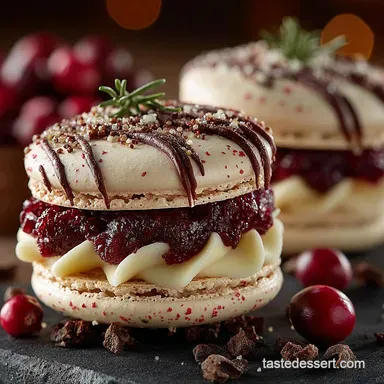
Yuletide Jewels Cranberry White Chocolate Macarons Italian Method

- Elevating Your Holiday Baking Game
- Essential Components for Macaron Success
- Precision Equipment That Makes All the Difference
- Preparing the Signature Macaron Shells
- Assembling Our Seasonal Christmas Macarons
- Expert Troubleshooting: Saving Your Macaron Batch
- Maximizing Flavor and Festive Options
- Recipe FAQs
- 📝 Recipe Card
Elevating Your Holiday Baking Game
This Christmas season, move beyond simple sugar cookies and embrace a true challenge that rewards precision with sheer edible luxury: the exquisite macaron. These delicate almond meringue sandwiches are the gold standard of patisserie, and incorporating them into your festive menu instantly stamps your celebration with elegance and refinement.
Our carefully engineered approach guarantees a batch of show stopping Christmas Macarons that boast vibrant color, perfect feet, and deeply satisfying chewiness.
This isn't just baking; it's culinary architecture, resulting in a sweet that is arguably the most coveted piece among Bakery Recipes Unique to the holiday season.
Why We Choose the Stable Italian Meringue Method
For those attempting the often temperamental macaron at home, stability is paramount. While the French method is simpler, the Italian meringue method offers superior control, making it ideal for large format or highly colored batches.
By incorporating hot sugar syrup, precisely heated to 115° C ( 240° F), into whipping egg whites, we create a structure that is far more robust and less prone to collapsing during the critical folding stage (macaronage).
This stability helps produce the coveted smooth tops and consistent "feet," providing a much higher success rate for this ambitious christmas macarons recipe .
The Perfect Pairing: Tart Cranberry Meets Sweet White Chocolate
When crafting truly exceptional treats, the flavors must resonate with the season. We’ve moved past simple vanilla to embrace the complexity of our chosen christmas macarons flavors : tart cranberry paired with rich white chocolate.
The cranberry component is reduced down into a concentrated, slightly acidic jam, infused with a hint of warming cinnamon. This intense fruit essence cuts through the sweetness of the white chocolate ganache, creating a balanced and addictive filling.
These Festive Macaron Flavors capture the essence of winter without being cloyingly sweet.
Are These Christmas Macarons Worth the Effort?
In a word: absolutely. It is true that macarons require exact measurements, attention to detail, and patience they are rated "Hard" for a reason. But the resulting visual impact and textural delight of homemade Holiday Macarons Christmas are unparalleled.
They are the definition of a showstopper dessert. Expect the total time, including the crucial two-hour resting phase, to run around three and a half hours, but the reward is 30 to 35 perfect, jewel toned pastries that will solidify your reputation as the ultimate host.
Essential Components for Macaron Success
Mastering the macaron starts not with the mixing bowl, but with the scale. Because the Italian meringue method relies on chemistry, every single ingredient from the almond flour to the water must be weighed precisely in metric units.
The fundamental components are the tant pour tant (TPT, equal parts almond flour and powdered sugar), the aged egg whites, and the sugar syrup. Compromising on ingredient quality or measurement accuracy here virtually guarantees failure.
On top of that,, using egg whites that have been separated and allowed to "age" for 24– 48 hours at room temperature is essential, as this process slightly lowers the moisture content, strengthening the final meringue.
Precision Equipment That Makes All the Difference
You cannot successfully bake quality Macaron Christmas shells without the right tools. Skip the approximations of volume measurements and invest in accurate equipment. A digital kitchen scale is non-negotiable for measuring every ingredient.
Equally vital for the Italian method is a reliable candy thermometer, which tracks the sugar syrup temperature to the degree. Finally, a stand mixer is strongly recommended, as the meringue requires vigorous, continuous whipping while the hot syrup is streamed in, a task nearly impossible to execute safely and effectively with a standard hand mixer.
The Shell Specifics: Weight and Quality of Almond Flour
The quality of your almond flour directly impacts the smoothness of your shells. We require 125g of finely ground almond flour and 125g of powdered sugar. These two ingredients are first blitzed briefly in a food processor (to break up any residual clumps) and then sifted at least twice to ensure the TPT mixture is absolutely free of grainy debris.
Any lumpiness left in the TPT will result in lumpy, fragile shells.
Achieving Stability: Supplies for the Italian Meringue Syrup
The stability of the meringue depends on the rapid heating of the sugar and water. The syrup requires 125g of granulated sugar combined with 40ml of water. This mixture is heated on the stovetop until it achieves a perfect soft ball stage of 115° C ( 240° F).
The remaining 60g of room temperature, aged egg whites are then the base into which this super heated syrup is streamed, cooking the egg whites and creating an incredibly sturdy structure.
Crafting the Filling: Luxurious White Chocolate Ganache Buttercream
The filling is where our festive theme shines through. We start with 200g of high-quality white chocolate combined with 100ml of heated heavy cream to form a smooth ganache. The tart element comes from 100g of fresh or frozen cranberries, simmered down with 50g of sugar and 1/4 tsp of cinnamon to create a deep, strained reduction.
Once cooled, this ruby red reduction is blended into the white chocolate base, resulting in robust Macaroons Flavors Recipes perfect for winter.
Must Have Tools for Consistency and Accuracy
Beyond the scale and thermometer, consistency relies on specialized items. Silicone baking mats, often featuring printed macaron templates, ensure that heat is distributed evenly and the shells peel off cleanly without breakage.
For forming the shells, a piping bag fitted with a round tip (such as a Wilton 1A) guarantees uniform sizing. Finally, a robust rubber spatula is key for the delicate process of macaronage.
Coloring the Shells: Achieving Deep Festive Reds
To achieve that rich, Yuletide red, proper coloring is crucial. Liquid food coloring adds too much moisture and will immediately ruin the consistency of the batter. You must use a highly concentrated gel or paste coloring (approximately 1/2 tsp).
The best practice is to incorporate this color directly into the pâte d'amande —the initial paste of the TPT and the first portion of egg white before adding the meringue, ensuring deep saturation without overmixing the final batter.
Related Recipes Worth Trying
- Cranberry Sage Stuffed Turkey Breast Christmas Recipes — Ditch the fuss with this foolproof stuffed turkey breast recipe Its one of the best traditional Christmas recipes featuring festive stuffing and an easy...
- Foolproof French Meringue Macarons Recipe Silky Shells at Home — Master the classic French Meringue Macarons recipe Learn the macaronage stage for perfect feet and chewy centers Your guide to homemade aesthetic macarons
- Ultimate Dark Chocolate French Macarons Recipe with Ganache — Conquer luxury Chocolate Macarons This recipe promises thick macaron shells and a rich filling Perfect your technique with our foolproof tips
Preparing the Signature Macaron Shells
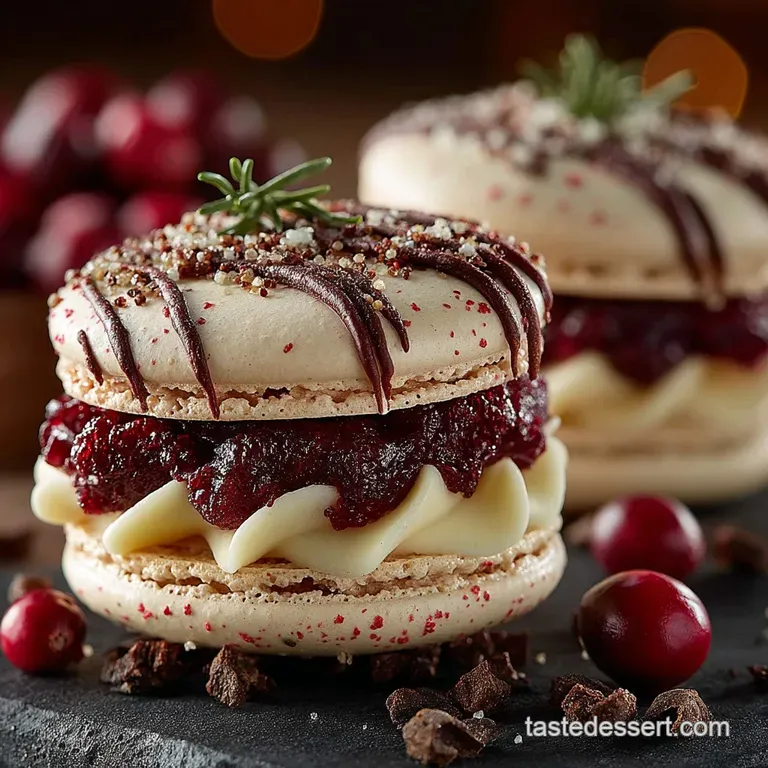
The process of creating the perfect shell is broken down into four distinct, sequential stages, each demanding focused attention to technique.
Mixing the Dry Ingredients (Tant Pour Tant)
Begin by thoroughly sifting your prepared 125g almond flour and 125g powdered sugar. In a separate bowl, measure 60g of the aged egg whites and stir in the red gel coloring until fully incorporated.
Add this colored egg white mixture to the TPT and stir just until a thick, uniform paste ( pâte d'amande ) forms. This paste will look unappealingly stiff, but it serves as the base that will later be thinned by the meringue.
Whipping the Syrup and Building the Meringue
While the TPT sits, combine the 125g sugar and 40ml water and begin heating on medium heat. Simultaneously, begin whipping the remaining 60g of egg whites in your stand mixer until they reach soft peaks.
As soon as the syrup reaches exactly 115° C ( 240° F), remove it from the heat. Immediately pour the hot syrup slowly and steadily down the side of the running mixer bowl (on medium high speed), avoiding the whisk head.
Continue whipping until the meringue is incredibly stiff, glossy, and the bowl has cooled completely to room temperature.
Mastering the Macaronage Fold Technique
This is the point where many batches fail. Macaronage is the gentle folding of the Italian meringue into the pâte d'amande . Start by folding one-third of the stiff meringue into the paste to loosen and soften it. Then, fold in the rest of the meringue in two additions.
Use a sweeping "J-stroke," scraping the sides, and pressing the spatula through the center of the batter. Stop folding precisely when the batter begins to flow slowly and continuously off the spatula in a thick ribbon this is the 'ribbon stage.' The ribbon should settle back into the main batter after about 20 seconds.
Pumping, Drying, and Baking the Perfect Feet
Transfer the ready batter to a piping bag fitted with a round tip. Pipe uniform 1.5 inch circles onto the silicone mats. Once piped, aggressively tap the trays 5 6 times on the counter to remove trapped air bubbles; pop any remaining bubbles with a toothpick.
Crucially, allow the shells to rest in a draft free location for a minimum of two hours. The shell is ready when a delicate, non-sticky 'skin' has formed. Preheat your oven to a low 140° C ( 285° F) and bake one tray at a time for 15– 18 minutes, or until the iconic "feet" have fully risen and the shell doesn't wobble.
Assembling Our Seasonal Christmas Macarons
Once your stunning red shells are completely cool, the final stage is creating and marrying the festive filling to the perfect shells.
Creating the Cranberry Reduction for Flavor Depth
To maximize the impact of the cranberry, we first need to concentrate its flavor. Simmer the 100g cranberries, 50g sugar, and the cinnamon with a splash of water until the berries burst and the mixture noticeably thickens.
Crucially, strain this mixture through a fine mesh sieve, pushing firmly to extract all the flavored liquid and discarding the solids. This ensures the reduction remains smooth and does not clog the piping tip later. Cool this vibrant reduction completely.
Whipping the Smooth and Stable Buttercream Filling
Prepare the white chocolate ganache by heating the heavy cream until steaming and pouring it over the chopped 200g white chocolate. Stir until silky smooth. Once the ganache base has cooled slightly, whisk in the fully chilled cranberry reduction until uniform in color and texture.
Cover and chill the filling for about an hour until it is firm enough to hold its shape when piped.
Finishing the Christmas Macarons
Matching shells by size is key for neat presentation. Transfer the chilled ganache filling to a piping bag. Pipe a tidy ring of ganache around the perimeter of one shell, leaving a small well in the center.
Pipe a second, smaller dollop of the remaining cranberry reduction inside that ring for a burst of pure fruit flavor in the center. Gently sandwich the pair together, twisting slightly until the filling spreads to the edges.
Allow the finished christmas macarons recipe to mature in the refrigerator overnight before serving; this process softens the shell to the perfect chewy consistency.
Expert Troubleshooting: Saving Your Macaron Batch
Macarons are notorious for their demanding nature. Knowing how to diagnose and address common errors is essential for confidence in the kitchen.
Diagnosing Hollow Shells and Cracked Tops
Hollow shells are usually caused by either baking too hot or under baking. If the inside collapses before setting, it leaves an air pocket. Try lowering your oven temperature slightly (staying strictly at 140° C or below) or increasing the bake time by two minutes.
Cracked tops, conversely, are almost always due to insufficient drying time. If the air escapes through the top instead of being forced down to create the feet, the shell cracks. Ensure the shell passes the touch test completely no stickiness whatsoever even if it takes longer than the minimum two hours.
What to Do If Your Macaron Batter Is Too Runny
If you’ve folded the batter past the ribbon stage, it is tragically overmixed, meaning the meringue structure has broken down, and the batter is too liquid to pipe or hold its shape. Unfortunately, there is no way to salvage an overmixed macaron batter.
The best course of action is to immediately stop folding the moment you hit the ribbon stage. If you find yourself with runny batter, you can spread it thinly on a sheet and bake it into simple almond cookies, but they will not produce macarons.
Proper Storage and Shelf Life for Baked Macarons
Baked, empty shells can be stored in an airtight container at room temperature for up to three days, or frozen for up to a month. However, these delicate pastries are at their absolute best after assembly. Once the Christmas Macarons are filled, they must mature in the refrigerator overnight.
This allows the moisture from the filling to soften the shell texture. Filled macarons are best consumed within 3 5 days, kept airtight in the fridge.
Maximizing Flavor and Festive Options
These christmas macarons ideas offer great flexibility, allowing you to tailor the flavors and presentation to your specific holiday gathering.
Alternative Filling Ideas for Holiday Variety
If you wish to expand your selection beyond the cranberry, consider shifting to other quintessential holiday notes. A popular choice is Peppermint Bark Macarons, using a rich dark chocolate ganache filling and garnishing the shell with crushed candy canes. For a spicy, rustic feel, craft Gingerbread Macarons.
You can incorporate 1 tsp of gingerbread spice directly into the TPT mix and fill them with a tangy cream cheese frosting.
Nutritional Overview of These Deluxe Christmas Macarons
While these are undeniably rich desserts, portion control is built into the tiny package. Based on an estimated serving size of one filled macaron, these delicate treats contain approximately 120 135 kcal.
They primarily consist of carbohydrates (around 14g), stemming from the almond flour and sugars, and a moderate amount of total fat (around 7g). They are naturally gluten-free due to the reliance on almond flour.
Recipe FAQs
I’m not getting the classic "feet" on my shells am I missing something crucial?
Ah, the legendary ‘foot’! If they aren't rising, you’ve likely had a spot of bother with the macaronage (the folding technique). Either the batter was under mixed (too thick) or more commonly over-mixed (too runny).
The macaronage stage is ready when the batter flows like a slow, continuous ribbon off your spatula.
Also, don't skimp on the drying time; the 'skin' must be completely dry to the touch. This forces the heat downwards, resulting in those beautiful ruffled feet, much like waiting patiently for a highly important train.
How far in advance can I make these beautiful Christmas Macarons?
Macarons actually benefit from a little aging! Once filled, they should chill in the fridge overnight to allow the moisture from the ganache to mature the shells, resulting in that perfect chewy texture.
For maximum efficiency during the festive rush, you can store the unfilled shells in an airtight container at room temperature for up to a week.
If you’re planning weeks ahead, finished macarons freeze beautifully for up to two months. Thaw them slowly overnight in the fridge, then bring them to room temperature before serving a proper logistical triumph for Christmas dinner!
Why did my macaron shells crack in the oven? It's a disaster!
Don’t panic, baking cracking is a common issue, often due to trapped air or moisture. First, ensure you aggressively tapped the trays immediately after piping to release air bubbles; if you see any remaining, pop them with a toothpick.
The other major culprit is insufficient resting time. If the 'skin' hasn't formed properly before baking, the internal moisture escapes explosively, causing those unsightly cracks. Ensure your oven temperature is stable and accurate use a thermometer, as even 5°C too hot can cause chaos.
The Italian method seems tricky; are these macarons really worth the fuss, and what about the sugar content?
Absolutely, they are the crown jewels of Christmas baking and entirely worth the effort! While the Italian meringue method involves the extra step of boiling sugar syrup, it provides the most stable meringue, making the entire batch far less temperamental especially helpful for deep festive colours.
Regarding nutrition, macarons are inherently sugar heavy due to the nature of the meringue (mostly sugar and almond flour). They are small, rich indulgences, and while they aren't calorie light, they are naturally gluten-free. Think of them as a treat to be savoured, not scoffed!
I fancy a different festive flavour for the filling are there easy swaps for the cranberry?
Certainly! Macarons are incredibly versatile. For a quick swap, substitute the cranberry reduction with a thick, reduced Passionfruit puree for a tropical twist, or use a good quality raspberry jam, reducing the sugar in the ganache slightly to balance the sweetness.
For a perfect holiday alternative, you could incorporate gingerbread spice into the shells and fill them with a classic brown butter buttercream. Just remember to use gel or powdered flavouring whenever possible to avoid upsetting the precise moisture balance of the shells.
Cranberry White Chocolate Christmas Macarons