Prime Rib Roast Oven: the Velvety Interior Method
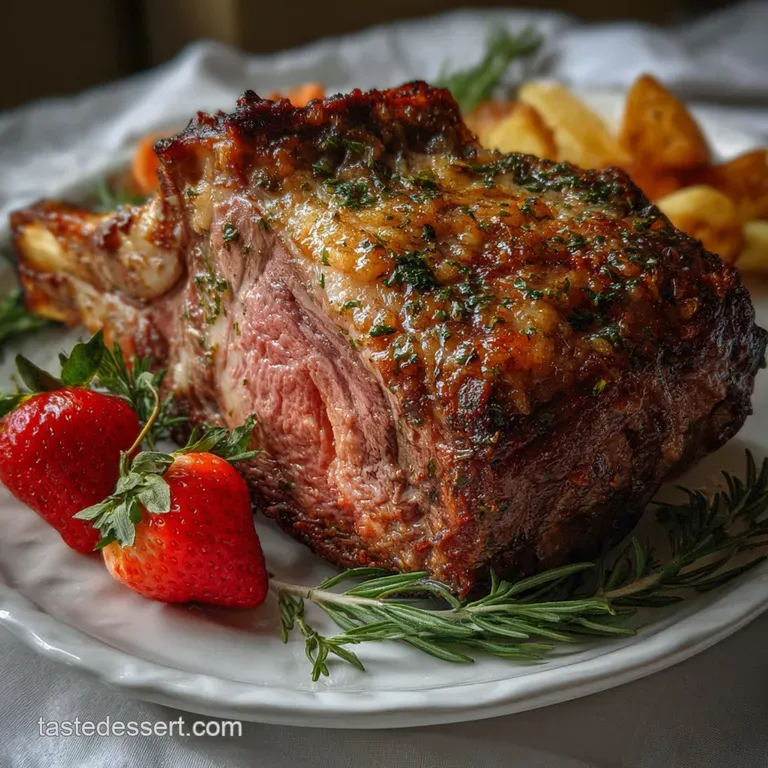
- Effort/Time: High precision / 4 hours total.
- Flavor Hook: Deeply caramelized garlic-herb crust with a concentrated red wine reduction.
- Perfect for: A show-stopping holiday centerpiece or a high-end Paleo beef dinner.
Achieving the Ultimate Crust with This Prime Rib Roast Oven
There is nothing quite like the stomach churning realization that you’ve turned a $150 investment into expensive shoe leather. I’ve been there standing over a prime rib roast oven that looked magnificent on the outside but was gray, dry, and overcooked just two inches beneath the surface.
It’s a technical failure that stings both the palate and the wallet, usually caused by aggressive, over high heat roasting that shocks the muscle fibers.
I once spent an entire Christmas Eve frantically trying to "fix" a roast I hadn't tempered properly; the center was practically raw while the exterior was curling into jerky. It was a humbling lesson in thermodynamics that changed how I approach large format proteins forever.
You cannot rush the physics of heat transfer in a 9 pound piece of meat.
The secret to a world class prime rib roast oven lies in the reverse sear and the Maillard reaction. By roasting at a low temperature, we allow the meat's natural enzymes to tenderize the tissue while maintaining moisture.
The final over high heat blast creates a mahogany, umami rich crust that yields to a tender, buttery center. Let's get into the mechanics of why this works.
Thermal Physics Behind a Uniformly Pink Center
- Enzymatic Tenderization: Between 100°F and 120°F, cathepsins (natural enzymes) break down connective tissue rapidly. A slow roasting prime rib roast oven spends more time in this "tenderizing zone" than one cooked at high heat.
- Surface Dehydration: Low-temperature roasting dries the exterior of the prime rib roast oven more effectively. A dry surface undergoes the Maillard reaction faster during the sear, creating a shattering crust without overcooking the interior.
- Gradient Minimization: High heat creates a steep temperature gradient, causing the outer layers to reach 160°F before the center hits 125°F. Keeping the prime rib roast oven at a low ambient temp ensures the entire mass heats evenly.
Critical Time and Yield Metrics for Your Roast
This prime rib roast oven is designed to serve a crowd, providing generous portions with enough structure for leftover sandwiches.
| Metric | Value |
|---|---|
| Total Yield | 9 servings |
| Prep Time | 30 minutes |
| Cook Time | 3 hours 30 mins |
| Total Time | 4 hours |
| Roast Weight | 9 lbs (4 bone) |
The Alchemy of Umami: Selecting Your Elements
Selecting the right components for your prime rib roast oven is the difference between a meal and a memory.
- 1 (4 bone) Standing Rib Roast (9 lbs): Why this? The bones act as a thermal shield, protecting the meat from direct heat.
- 3 tbsp Diamond Crystal Kosher Salt: Why this? Large flakes allow for even distribution and controlled osmotic pressure.
- 2 tbsp Coarse black pepper: Provides the necessary bite to cut through the high fat content.
- 1/2 cup Unsalted butter (softened): Why this? High fat-to-water ratio creates a stable emulsion for the herb rub.
- 6 cloves Garlic (minced): Adds sulfurous depth that intensifies during the final sear.
- 2 tbsp Fresh rosemary (finely chopped): Resinous notes that stand up to long cook times.
- 2 tbsp Fresh thyme (finely chopped): Earthy aromatics that bridge the gap between beef and red wine.
- 1 tbsp Worcestershire sauce: Why this? Anchovy based umami compounds catalyze the Maillard reaction.
- 2 cups Beef stock: The base for your au jus; use high-quality, collagen rich stock.
- 1/2 cup Dry red wine: Acidity balances the richness of the rendered beef tallow.
Ingredient Chemistry Breakdown
| Ingredient | Chemical/Physical Role (Science) | The Pro Secret (Why This Matters) |
|---|---|---|
| Standing Rib Roast | Myoglobin retention and collagen hydrolysis | over Low heat prevents myoglobin from turning gray, keeping it pink. |
| Kosher Salt | Osmotic pressure and protein denaturing | Draws moisture out, dissolves, then pulls brine back into the fibers. |
| Unsalted Butter | Lipid based heat conduction | Acts as a medium to "fry" the herbs against the meat surface. |
| Dry Red Wine | Alcohol soluble flavor extraction | Alcohol pulls out flavors from garlic/herbs that water cannot. |
Essential Precision Tools for Professional Results
To master the prime rib roast oven, you need tools that offer consistent feedback.
- Lodge Cast Iron Roasting Pan: Provides superior heat retention and a stable base for the 9 pound mass.
- ThermoWorks Thermapen One: This is non-negotiable; you must measure internal temperature, not time.
- Large Wire Cooling Rack: Elevates the meat to allow 360 degree airflow, preventing a soggy bottom.
- Kitchen Twine: Essential for tying the roast to ensure it maintains a uniform cylindrical shape.
Precision Temperature Control Protocol for the Perfect Sear
Follow these steps exactly to ensure your prime rib roast oven reaches its full potential.
- Temper the meat: Remove the 9 lb roast from the fridge 2 hours before cooking until the internal chill dissipates. Note: Reduces the thermal shock of the oven.
- Dry and season: Pat the surface bone dry with paper towels and coat with 3 tbsp salt and 2 tbsp pepper until the entire surface feels textured. Note: Dry surfaces brown more efficiently.
- Prepare herb compound: Combine 1/2 cup butter, garlic, rosemary, thyme, and Worcestershire until a thick, uniform paste forms.
- Apply rub: Slather the butter mixture over the top and sides of the prime rib roast ovenuntil the meat is fully masked in green and white.
- Initial roast: Place in a 250°F (120°C) oven until the internal temperature reaches 120°F (49°C) for medium rare. Note: Low heat prevents the outer layers from overcooking.
- The resting phase: Remove from oven, tent loosely with foil, and rest for 45 minutes until the internal temperature stabilizes and begins to drop. Note: Allows juices to redistribute into the muscle fibers.
- The over high heat blast: Crank the oven to 500°F (260°C). Return the roast for 6 10 mins until the exterior is mahogany and sizzles loudly.
- Deglaze the pan: While the roast sits, simmer 2 cups beef stock and 1/2 cup red wine in the roasting pan until the liquid reduces by half and coats a spoon.
- Carve against the grain: Slice the prime rib roast oven into thick slabs until the velvety pink interior is revealed.
If you’re looking for a slightly different cut or method, my BoneIn Rib Roast recipe covers the nuances of smaller, select cuts.
Why Your Roast is Gray: Troubleshooting Thermal Failures
A gray ring is the hallmark of heat entering the meat too quickly. When the exterior is exposed to 400°F for the entire duration, the proteins denature and squeeze out all moisture before the center even warms up.
| Problem | Root Cause | The Fix | Pro Protocol |
|---|---|---|---|
| Gray Ring | Temperature gradient too steep | Lower the initial oven temp to 225°F-250°F. | Pull the meat 5°F before your target; carryover is real. |
| Tough Texture | Skipping the resting phase | Rest for at least 30 45 mins. | Use a warm, draft free spot for resting, not the fridge. |
| No Crust | Surface moisture too high | Pat the meat bone dry before seasoning. | Dry-brine in the fridge uncovered for 24 hours. |
Flavor Architecture: Creative Adjustments for This Prime Rib
While the classic herb butter is timeless, you can shift the profile of your prime rib roast oven to suit different themes.
- Spicy Horseradish Crust: Fold 3 tbsp of prepared horseradish into the butter rub for a sharp, sinus clearing bite.
- Smoked Paprika & Garlic Rub: Replace rosemary with 2 tbsp of smoked paprika for a deeper, smokier profile that mimics an outdoor grill.
- Keto/Paleo Adjustment: This recipe is naturally compliant; just ensure your beef stock contains no added sugars or starches.
Substitution Table
| Original Ingredient | Substitute | Why It Works |
|---|---|---|
| Unsalted Butter | Ghee (1/2 cup) | Higher smoke point; maintains the buttery flavor for Paleo beef diets. |
| Dry Red Wine | Pomegranate Juice | Adds similar acidity and tannins without the alcohol content. |
| Fresh Rosemary | Dried Herbs (2 tsp) | Use less, as dried herbs are more concentrated. Note: Texture will be grittier. |
If you're intimidated by the size of a full standing roast, start with my Foolproof oven-roasted recipe for beef tenderloin to practice your temperature control.
⚗️ The Scaling Lab: The Physics of Quantity
When doubling this prime rib roast oven (cooking two 9 lb roasts), the physics of your oven changes significantly.
- Thermal Mass Recovery: Two roasts represent 18 lbs of cold mass. Your oven temp will drop by 50°F+ when you load them. Increase the initial temp to 275°F for the first 20 minutes to recover, then drop back to 250°F.
- Airflow Obstruction: Two large pans can block convection. Ensure there is at least 3 inches of space between the pans and the oven walls, or the centers will remain raw while the tops burn.
- Non-Linear Spice Scaling: Do NOT double the salt. Scale salt to 1.5x (4.5 tbsp) for two roasts. Excess salt on the surface can draw out too much moisture in a crowded, humid oven.
- The Square Cube Law: A larger mass has less surface area relative to its volume. Carryover cooking will be more intense. Pull two roasts at 115°F, as they will climb significantly higher than a single roast during the rest.
Debunking Common Roasting Myths
- Myth: Searing first "locks in the juices."
- Truth: Searing actually creates a steam proof barrier that increases moisture loss during the long roast. Always sear last.
- Myth: You must cook bone-in for flavor.
- Truth: The bones don't actually flavor the meat (the molecules are too large to penetrate), but they DO act as an insulator for a more even cook.
Managing Leftovers: Preservation and Reheating Science
Leftovers from a prime rib roast oven are a gift, but only if you prevent lipid oxidation (that "warmed over" funky taste).
- Storage: Wrap tightly in plastic wrap, then foil. Store in the fridge for up to 4 days or freeze for 2 months.
- Reheating: Use a "low and slow" method. Place slices in a baking dish with a splash of au jus, cover with foil, and heat at 250°F until just warm. High heat will turn your medium rare pink into gray rubber.
- Zero Waste Philosophy: Don't discard the bones! Transform: Simmer the 4 bones with veggie scraps for 6 hours. Science: The marrow and connective tissue release gelatin, creating a velvety, nutrient dense bone broth.
Final Assembly and Presentation for a Festive Dinner
To serve, place the prime rib roast oven on a heavy wooden board. Carve the meat away from the bones in one large piece, then slice the roast into 3/4 inch thick portions. This ensures every guest gets a piece of the garlic herb crust.
Leftovers make an incredible Philly Cheesesteak Recipe the next day, where the pre-cooked tenderness of the ribeye shines. Pour the reduced red wine au jus into a warm gravy boat and serve immediately while the fat is still emulsified. Your prime rib roast oven is now ready to be the centerpiece of your table. Trust the thermometer, respect the rest, and enjoy the sizzle.
Recipe FAQs
How to make prime rib oven roast?
Dry brine, coat with herb butter, roast reverse sear style. This ensures the internal temperature rises slowly to 120°F before a high heat blast creates the crust.
If you enjoyed mastering temperature precision here, apply that same control when you [mastering X technique] see how the same principle works in [How to Make the Best Herb Infused Irish Roast Chicken: 5 Secrets!].
How to cook a prime rib oven roast?
Roast low (250°F) until 120°F, then blast high (500°F) for 10 minutes. This low-to-high technique minimizes the temperature gradient, preventing the gray band below the crust. The initial low temperature allows for enzymatic tenderization, increasing succulence.
How to cook a prime rib oven roast cap off?
Remove the fat cap before dry-brining and rubbing. Removing the cap allows the herb rub to directly contact the meat, promoting a more uniform crust. The cap’s thick fat layer slows conduction, so removing it ensures the surface browns evenly during the final sear.
How to cook a prime rib oven roast in a slow cooker?
Use the low setting for 8-10 hours for medium rare; no high heat sear possible. While possible, the slow cooker cannot achieve the Maillard reaction crust necessary for this recipe.
For a slow cooker alternative, reference our [Easy & Juicy how to cook a roast in a crock pot: My Fail Proof Herb Glazed Method].
How to cook a prime rib oven roast convection oven?
Reduce initial temperature by 25°F and check early. Convection circulates hot air rapidly, causing surfaces to cook faster than in a conventional oven. If you enjoyed controlling dough spread here, see how the same fat ratio logic applies to [How to Create My Oven Baked Veggie Medley Delight: 5 Easy Steps!].
Should I sear prime rib before or after slow roasting?
Sear after slow roasting for minimal moisture loss. Searing first creates a hardened barrier that traps steam, forcing internal moisture outward as the interior heats. This scientific process maximizes the temperature difference, resulting in a thicker gray ring.
What is the best pan for prime rib oven roast?
A heavy cast iron pan or a sturdy roasting pan with a rack. Heavy pans maintain stable thermal energy when the cold roast is introduced, minimizing temperature fluctuation. The rack elevates the meat, promoting necessary 360-degree airflow for uniform cooking.
Prime Rib Roast Oven Mastery
Ingredients:
Instructions:
Nutrition Facts:
| Calories | 845 kcal |
|---|---|
| Protein | 64g |
| Fat | 62g |
| Carbs | 3g |
| Fiber | 1g |
| Sugar | 1g |
| Sodium | 1180mg |
